
Football stadiums often become symbols of a generation. A few become national landmarks. Only one has become a living chapter book of FIFA World Cup history.
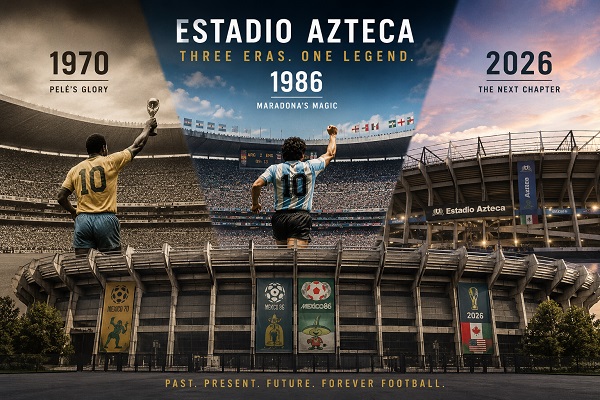
Estadio Azteca in Mexico City stands alone as the only stadium to host matches in three separate FIFA World Cups. It witnessed Pelé’s crowning achievement in 1970. It became the stage for Diego Maradona’s most famous and controversial moments in 1986. In 2026, it will once again welcome the world’s greatest tournament.
Across more than half a century, Azteca has survived changing eras, evolving tactics, and multiple generations of football legends. Its story is not simply the history of a stadium. It is the history of the World Cup itself.
Truth Box
| Key Point | Insight |
|---|---|
| Unique Record | Estadio Azteca is the first stadium to host World Cup matches in three separate tournaments |
| Pelé’s Legacy | Brazil won the 1970 World Cup Final at Azteca |
| Maradona’s Legacy | The Hand of God and Goal of the Century happened at Azteca in 1986 |
| Massive Capacity | The stadium has historically held over 100,000 spectators |
| 2026 Significance | Azteca will become the centerpiece of an unprecedented third World Cup chapter |
The Stadium That Refuses to Fade
When Estadio Azteca opened in 1966, few could have predicted its future significance.
Built in Mexico City, the venue was designed to showcase Mexico’s growing influence in international sports. The stadium quickly became one of the largest and most intimidating football venues in the world.
What separates Azteca from other historic grounds is longevity.
Many famous World Cup stadiums host a tournament and fade into memory. Azteca continually reinvents itself while preserving its historical importance.
Its location at more than 2,200 meters above sea level has challenged players for decades. Visiting teams often struggle with the thin air, making every match a physical test.
The First Lifetime: Mexico 1970 and Pelé’s Greatest Triumph
The 1970 FIFA World Cup is often considered one of the greatest tournaments ever played.
At its center stood Pelé and an extraordinary Brazilian team featuring Jairzinho, Tostão, Rivellino, and Carlos Alberto.
Why 1970 Changed Football
The tournament introduced a more global television audience to football than ever before.
Brazil played a beautiful attacking style that captured the imagination of fans worldwide.
The final against Italy remains one of football’s iconic matches.
Brazil’s 1970 Final at Azteca
| Match | Result |
| Brazil vs Italy | 4-1 |
| Date | June 21, 1970 |
| Venue | Estadio Azteca |
| Attendance | More than 100,000 |
Carlos Alberto’s famous goal remains one of the greatest team goals in World Cup history.
When Pelé lifted the Jules Rimet Trophy at Azteca, the stadium entered football immortality.
The Second Lifetime: Mexico 1986 and Maradona’s Immortality
Sixteen years later, Azteca became the stage for another football legend.
This time it was Diego Maradona.
The Argentine captain produced arguably the greatest individual World Cup campaign ever witnessed.
The Hand of God
On June 22, 1986, Argentina faced England in a quarterfinal loaded with political and sporting tension.
Maradona scored one of football’s most controversial goals by punching the ball into the net.
The referee allowed the goal to stand.
Maradona later described it as being scored “a little with the head of Maradona and a little with the hand of God.”
The Goal of the Century
Only minutes later, Maradona created magic.
Picking up the ball inside his own half, he dribbled past multiple English players before scoring.
Many historians and analysts consider it the greatest goal in football history.
Maradona’s 1986 World Cup Record
| Category | Total |
| Goals | 5 |
| Assists | 5 |
| Matches | 7 |
| Trophy Won | FIFA World Cup |
| Golden Ball | Yes |
By the end of the tournament, Maradona had elevated himself into football mythology.
Azteca became forever linked to his legacy.
The Third Lifetime: FIFA World Cup 2026
The FIFA World Cup 2026 represents another historic milestone.
For the first time, the tournament will be hosted by three countries: the United States, Canada, and Mexico.
Amid dozens of modern venues, Estadio Azteca remains the crown jewel.
Why 2026 Matters
The stadium will achieve something no other venue has accomplished.
It will host World Cup matches in:
| Tournament | Host Country |
| 1970 | Mexico |
| 1986 | Mexico |
| 2026 | Mexico |
This unique achievement highlights Azteca’s unmatched status within football history.
Extensive renovations have modernized the stadium while preserving its identity.
The challenge facing organizers is balancing tradition with the expectations of a modern global audience.
Why Estadio Azteca Is Unlike Any Other Stadium
Several factors separate Azteca from every other football venue.
Historic Significance
No other stadium has hosted two World Cup Finals and appeared in three different tournaments.
Legendary Players
Pelé and Maradona produced defining career moments here.
National Identity
For Mexico, Azteca is more than a stadium. It is a cultural landmark.
Global Recognition
Fans across generations instantly recognize the venue’s name.
Historic World Cup Moments at Azteca
| Year | Event |
| 1970 | Brazil defeats Italy in the Final |
| 1970 | Pelé wins his third World Cup |
| 1986 | Hand of God goal |
| 1986 | Goal of the Century |
| 1986 | Argentina wins the World Cup |
| 2026 | Third World Cup chapter begins |
These moments span more than five decades of football history.
Very few sporting venues can claim such influence.
Estadio Azteca vs Other Legendary World Cup Stadiums
| Stadium | Country | World Cups Hosted | Finals Hosted |
| Estadio Azteca | Mexico | 3 | 2 |
| Maracanã | Brazil | 2 | 2 |
| Wembley Stadium | England | 1 | 1 |
| Lusail Stadium | Qatar | 1 | 1 |
| Soccer City | South Africa | 1 | 1 |
Azteca remains unique because its World Cup story stretches across multiple generations.
The Future Legacy of Azteca
The 2026 tournament will introduce Azteca to a new generation of supporters.
Many young fans know Pelé and Maradona only through highlights and documentaries.
Watching World Cup football inside the same stadium where those legends created history adds a powerful emotional connection.
The venue becomes a bridge between football’s past, present, and future.
Few sporting locations can claim such continuity.
As football continues to evolve, Estadio Azteca remains a reminder that some places transcend time.
Common Misconceptions
Myth: Azteca is the oldest major World Cup stadium
Reality: Many stadiums are older, but none share its World Cup record.
Myth: Pelé and Maradona played in the same era at Azteca
Reality: Their iconic World Cup moments occurred sixteen years apart.
Myth: 2026 will be Azteca’s first major renovation
Reality: The stadium has undergone multiple upgrades throughout its history.
Conclusion
Football’s greatest stories are often attached to people.
Estadio Azteca proves they can also belong to places.
The stadium witnessed Pelé’s brilliance in 1970 and Maradona’s genius in 1986. In 2026, it enters an unprecedented third chapter, becoming the only venue to host World Cup matches across three separate tournaments.
Few stadiums survive generations.
Even fewer shape them.
Azteca has done both.
Its three lifetimes tell the story of football itself.
Frequently Asked Questions
Q1. Why is Estadio Azteca famous?
Ans. It hosted historic World Cup moments involving Pelé, Maradona, and multiple championship matches.
Q2. How many World Cups has Estadio Azteca hosted?
Ans. It has hosted matches in 1970, 1986, and 2026.
Q3. What happened at Azteca in 1986?
Ans. Maradona scored both the Hand of God goal and the Goal of the Century.
Q4. Did Pelé win a World Cup at Azteca?
Ans. Yes. Brazil defeated Italy in the 1970 World Cup Final.
Q5. Why is the 2026 World Cup historic for Azteca?
Ans. It becomes the first stadium ever to host World Cup matches in three different tournaments.